
Your client emails you on a Tuesday. "I keep hearing about AI. What should I be doing?" This is the question the CAS profession has been waiting for since 2015 — when a client treats you as the advisor you've been calling yourself. Most firms can't answer it.
The reason isn't capability. It's credibility. You can't advise a client on something you haven't operated yourself. The deadline on the AI advisory transformation for CAS firms just moved up.
A decade of advisory talk is meeting its first real test
Every CAS conference runs a session on the advisory transformation. The promise — move from "doing the books" to "advising the business" — is a story we've been telling ourselves and our clients. Most firms still do mostly compliance work.
Two forces are converging that the prior decade didn't have to contend with. Compliance is commoditising visibly — AI categorisers, reviewers, and close-preparers compressing the work that funded the practice, faster than fees are dropping to match. Clients are also asking the advisory question — what do I do about AI? — that a compliance-only firm can't answer. The advisory promise has a deadline now.
Advisory means business advisory, not just financial advisory
Traditional CAS advisory was financial — virtual CFO, KPI dashboards, cash flow forecasts. Important work. Insufficient now.
The question your client is actually asking is operational: how do I run my business better with AI inside it? That's marketing, customer insight, hiring decisions, vendor selection, pricing, product strategy. Subjects accountants have left to other professionals.
The accountant has the strongest natural position to answer the operational question of anyone in the client's life. You have the trust. You have the data. You have the cadence — monthly contact, more than any other professional. You understand the business model.
What you lack is AI operational fluency. That gap is closeable, but it doesn't close by reading articles.
The credibility ceiling — what the PE deals proved this month
On May 4, Anthropic and OpenAI both announced multi-billion-dollar private-equity-backed enterprise services joint ventures the same morning. Goldman, Blackstone, and Hellman & Friedman joined Anthropic to deploy AI inside their portfolio companies. OpenAI's Deployment Co finalized the next week. Tomoro got acquired. The PE thesis is now explicit — AI deployment is the layer accountants need to understand as a portfolio service, with a 17.5% return guarantee structured around it.
Value is moving to the deployment layer — not the model, not the chatbot, the engineer embedded inside the client who makes it actually work. PE firms are claiming that role at enterprise scale by hiring it into their portfolio architecture. Your mid-market and SMB clients aren't getting that yet.
They're going to want the same thing — and they'll ask the professional already inside their business. That's you. Or it's the firm down the street that figured this out first.
The apparatus is portable — if it exists on your side
A SMB owner asking "what should I be doing about AI?" wants the kind of advice you give when you've done it yourself. They'll tolerate "let me research that" once. After that, they go to whoever sounds like they've lived through the question.
You can't advise on AI for a client without having operated it inside your own firm first. The agents that draft your client emails are the same shape as agents you'd help a client build. The discipline of catching when an agent drifts is the same discipline you'd teach a client. The whole apparatus is portable across the line — if it exists on your side.
Most firms are at Stage 1 — and Stage 1 is a dead end
Monday's roundup flagged the four-stage model and the trap on Stage 1. Here's the four-stage AI maturity model in full.
There are four stages a CAS firm can be at on this curve.
Stage 1 — Bolt-on. Individual practitioners using ChatGPT or Copilot alone. No shared context, no firm-wide compounding. The McKinsey 86%-with-no-executive-championing live here.
Stage 2 — Compressed. Specific pain points addressed with agents that have persistent context. The cost lever pulled deliberately. Workflows still look the same as pre-AI.
Stage 3 — Rebuilt. Workflows redesigned around what AI makes possible. Compliance compressed. Advisory expanded.
Stage 4 — Compounding. The firm sells niche-specific products that didn't exist before. Pricing pivot complete. Outcomes, not hours.
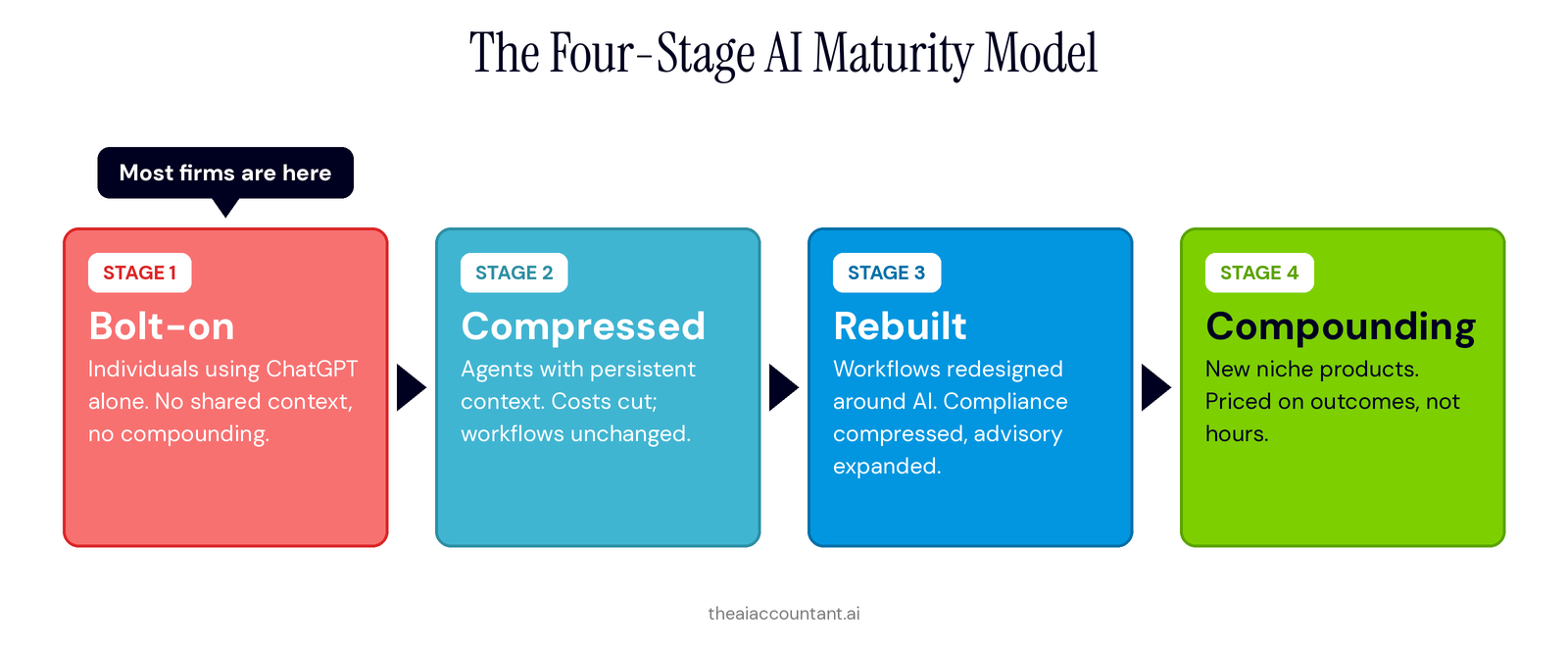
Most CAS practices are at Stage 1. Stage 3 is where the advisory transformation finally lives operationally. Stage 4 is the firm that earned the right to advise on AI by using AI to advise itself. If your advisory firm's AI strategy is "we use ChatGPT," you're in Stage 1. That's the dead end.
The work, not the workshop
The build from Stage 1 to Stage 3 is real work. It's also the work you've been telling yourself for ten years you wanted to do — the firm becoming the advisory practice with the operational backbone to match the promise. Next week we'll walk through the six-layer architecture that defines Stage 3: firm identity, tech stack map, client registry, workflow templates, agent slots, and monitoring. None of it is optional for the firm that wants to be the advisor.
Book a free consultation at theaiaccountant.ai/consultation. We'll scope a build you'll do internally, or scope what an outsourced engagement looks like. We're building a done-for-you version for owners who want to outsource — the consultation is where we figure out which side your firm sits on.